Remote Jobs Salary vs Local Jobs Salary: The Real Difference
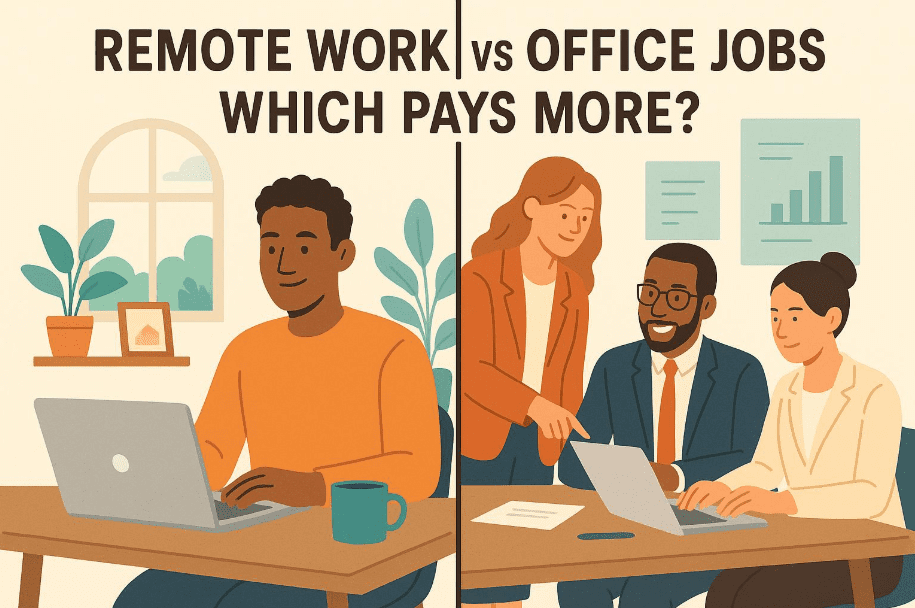
Can working from your living room actually earn you more than a traditional office job? In today’s Nigerian job market, the answer is a resounding yes, but with major caveats. The rise of remote work has created a parallel economy with a fundamentally different salary logic, shattering the old geographic constraints that once capped earnings.
This comparison moves beyond the anecdotal hype to dissect how compensation is determined in each model. We’ll unveil the new rules of the salary game, showing why a remote role can pay multiples of a local one, and when it might not.
The Core Distinction: Two Different Salary Logics
-
Local Job Salary: Anchored to the Nigerian cost of labor and local market rates. Your pay is benchmarked against what other companies in Lagos, Abuja, or Port Harcourt are offering for similar roles. It’s a closed, domestic system.
-
Remote Job Salary: Operates on global or regional market rates. Your compensation is benchmarked against what a company in Europe, North America, or even a pan-African startup pays for that skill set, often with a location-based adjustment. It’s an open, borderless system.
The Salary Divide: A Side-by-Side Breakdown
The disparity is most evident when comparing the same role under different employment models.
| Role & Experience | Local Nigerian Job (Gross Monthly) | International/Remote Job (Gross Monthly) | The Gap |
|---|---|---|---|
| Mid-Level Software Developer (3-5 yrs) | ₦500,000 – ₦1,200,000 Top of the range at leading local tech firms or banks. |
$2,500 – $5,500+ (≈ ₦2.5M – ₦5.5M+) Paid in USD by international firms or well-funded startups. |
300% – 400%+ Higher |
| Digital Marketing Manager | ₦350,000 – ₦800,000 For a brand or agency serving the Nigerian market. |
$1,800 – $3,500+ (≈ ₦1.8M – ₦3.5M+) Serving global markets for a SaaS or e-commerce company. |
200% – 350%+ Higher |
| Data Analyst | ₦280,000 – ₦600,000 In a Nigerian corporate setting. |
$2,000 – $4,000+ (≈ ₦2M – ₦4M+) Working with international datasets for a foreign company. |
250% – 500%+ Higher |
| Customer Support (Eng) | ₦120,000 – ₦250,000 Serving Nigerian customers. |
$1,000 – $2,000+ (≈ ₦1M – ₦2M+) *24/7 support for a global tech product.* |
400% – 700%+ Higher |
Key Insight: For globally competitive digital skills, remote work doesn’t just offer a slight bump—it can multiply your local earning potential by 3x to 7x or more, especially when payment is in hard currency.
The Remote Salary Hierarchy: Not All Remote Jobs Are Created Equal
-
International Remote (Paid in USD/GBP/EUR): The top tier. Salary is benchmarked to the company’s home country (often with an “emerging market” discount), leading to life-changing income differentials for Nigerians. Common in tech, design, and content.
-
Pan-African Remote (Paid in USD/NGN): A fast-growing segment. Salary is benchmarked regionally, often higher than local rates but below full international ones. Common with startups and telcos operating across Africa.
-
Local Remote (Paid in NGN): You work from home for a Nigerian company. Salary is based on local benchmarks, with perhaps a small premium for flexibility. The financial upside is minimal; the benefit is lifestyle.
The Hidden Costs & Trade-Offs of High-Paying Remote Work
That massive salary comes with its own set of challenges:
-
The Tax & Legal Gray Zone: Managing foreign income tax obligations in Nigeria and potentially the employer’s country requires professional advice. Payment methods (PayPal, Wise, crypto) can be unstable or costly.
-
No Traditional Benefits: You typically forfeit pension contributions (PenCom), HMO, and leave allowances unless specifically negotiated. You must self-fund these from your higher salary.
-
Absolute Performance Culture: Job security is tied 100% to output. There is no “office presence” to hide behind. You are competing with a global talent pool every day.
-
Professional Isolation & Career Path: Building a career ladder can be ambiguous. Networking happens digitally, and mentorship is less organic than in a local office.
The Local Job Advantage: Stability, Structure, and Context
A local salary buys more than just money:
-
Structured Career Progression: Clear paths to management, often with training and mentorship.
-
Integrated Benefits: Legally mandated HMO, pension, and sometimes housing/transport allowances.
-
Local Network & Relevance: The connections and market knowledge gained are invaluable for long-term careers in Nigeria and for future entrepreneurial ventures.
-
Lower Compliance Burden: Your employer handles all tax and regulatory deductions (PAYE).
Conclusion: It’s a Choice Between Two Economies
The difference between remote and local salaries isn’t just a pay gap; it’s a fundamental choice between two different economies and career models.
-
Choose Remote Work to maximize immediate income and gain global experience if you have in-demand digital skills, a high degree of self-discipline, and a tolerance for uncertainty.
-
Choose Local Work to build a stable, structured career within the Nigerian ecosystem, with clear benefits, physical networking, and a path that aligns with the local business landscape.
The Ultimate Strategy: Many top professionals now sequence these models: start with a high-paying international remote role to build capital rapidly, then transition to a senior local or hybrid role (with equity or leadership stakes) that leverages their global experience for even greater impact and stability in the Nigerian market. This approach captures the financial upside of remote work while mitigating its long-term risks.
Frequently Asked Questions (FAQs)
1. How do I even find these high-paying international remote jobs?
You compete on global platforms with a world-class profile. Key sources include:
-
Specialized Job Boards: RemoteOK, We Work Remotely, AngelList (for startups).
-
LinkedIn: Optimize your profile for keywords that international recruiters search for. Proactively signal “Open to Remote Work.”
-
Networking: Contribute to global open-source projects or online communities in your field. Your digital reputation becomes your CV.
The barrier to entry is high, but the opportunity is transparent.
2. Will Nigerian companies ever pay salaries competitive with remote international ones?
For truly world-class talent in scarce tech fields, some already are. To retain experts, leading Nigerian tech startups and fintechs are being forced to create “localized global” packages that compete with remote salaries, often by offering significant equity (stock options). However, this is currently the exception, not the norm, and is largely confined to the tech investment ecosystem.
3. Is the remote work trend sustainable, or will salaries drop as more people compete?
The trend of distributed work is sustainable, but specific salary levels may adjust. As more talent from emerging markets enters the pool, upward pressure on salaries may soften for generalist roles. However, for specialized, high-end skills (senior engineers, growth experts, AI researchers), the global shortage is so acute that premium salaries will remain. The key to sustaining high earnings is continuous skill specialization beyond the basics.